
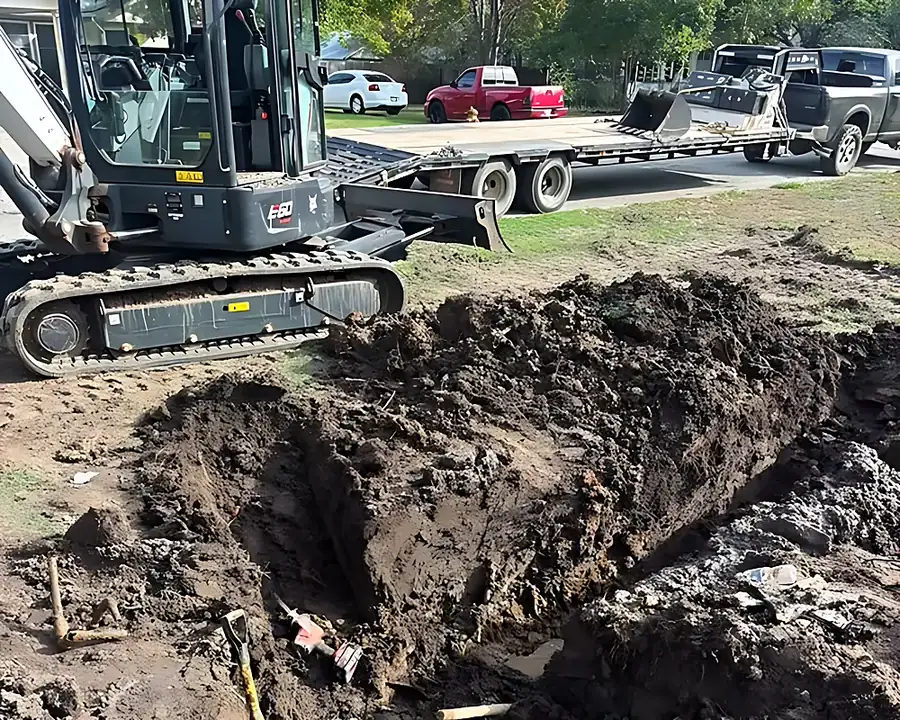
There are two ways to remove an in-ground pool. A partial removal drains it, breaks holes in the bottom, knocks the top of the walls down and fills the rest. A full removal takes the whole shell out before filling. Partial costs less. Full is better if you might ever build on that spot.
Before work starts
The pool equipment's power and gas have to be disconnected by an electrician or plumber. Some cities require a permit for pool removal. Plan how the machine gets into the back yard.
Partial removal
The pool is drained, holes are broken through the floor so water can drain out, the top of the walls and the deck are broken down into the hole, and the rest is filled with clean fill packed in lifts. The bottom of the old pool stays in the ground.
Full removal
The deck and the whole shell are broken out and hauled off, then the hole is filled and packed. Nothing of the pool is left. If you might build an addition, a shop or a slab there, this is the safer choice, and it is easier to explain when you sell.
The fill
The hole has to be filled with clean fill, placed in thin layers and packed one at a time. A pool filled with whatever dirt is handy will settle for years.
After
The ground is graded so it drains, ready for topsoil and seed or sod.
Vinyl, fiberglass and concrete
Vinyl liner pools have walls and a liner to pull out. Fiberglass shells are broken up. Concrete and gunite pools are the most work to break out.
Common Questions
How long does pool removal take?
Most residential removals take a few days, depending on size, access and fill.
Do I need to tell the buyer if I sell?
Talk to your real estate agent. Having records of how it was removed helps.
Can you dig a new pool too?
Yes. See pool digs and removal.
What to Do Next
Ready to get rid of the pool? Call (918) 320-3439 for an estimate.